Sunbelt Teams With Lucid Bots
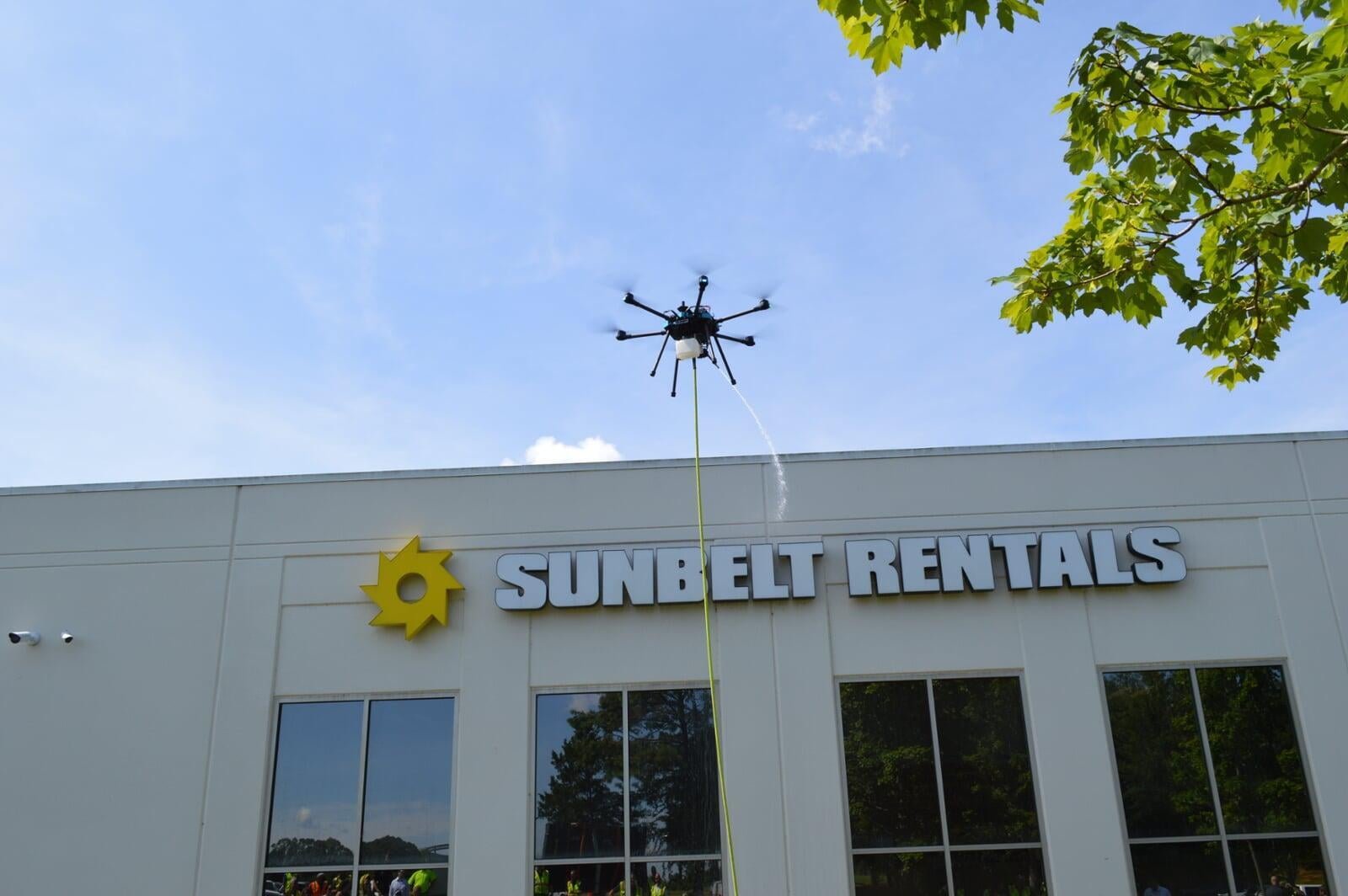
Sunbelt Rentals has entered into a strategic partnership with Lucid Bots
Sunbelt Rentals has entered into a strategic partnership with Lucid Bots.
The agreement calls for Sunbelt to make Lucid Bots cleaning drones available to the company’s rental customers nationwide. The two organizations will collaborate on an approved solution program for their clients, and the drones will be backed by Sunbelt’s support and service to maintain the equipment for optimal use.
“Partnerships like the one with Lucid Bots are what has enabled us to bring innovative solutions to our customers,” said Adam Camhi, Sunbelt vice president of flooring solutions. “With the Lucid Bots cleaning drone, our customers will have safer operations, reduce their environmental impact, and increase overall operator efficiency, while still completing tough exterior cleaning jobs.”
About Sunbelt
Fort Mill, South Carolina-based Sunbelt Rentals supplies a wide variety of rentals for the facility services market. For more information, visit www.sunbeltrentals.com.
Related Articles
.jpg)
Best Commercial Drone Building Cleaning
175 deals, $9.7M in operator revenue in 2025. The complete guide to commercial drone cleaning: how it works, what it costs, and how to get started.
The Complete Guide to Commercial Drone Cleaning in 2026: Equipment, Economics, and Getting Started
Published by Lucid Bots | Updated March 2026
Commercial drone cleaning has moved from novelty to mainstream. In 2025 alone, Lucid Bots operators closed 175 deals totaling $9.7 million in revenue, nearly doubling 2024. Across the full fleet, operators have generated over $75 million in combined revenue and completed more than 6,500 jobs across three continents.
This guide covers everything you need to know, whether you want to buy a drone and build a business or hire drone cleaning for your building. How the technology works, what it costs, who is buying, and how to get started.
Why Commercial Drones Are Replacing Traditional Building Cleaning
Commercial building cleaning is a $15 billion market growing by roughly $1 billion every year, and it can't find workers. Scaffolding crews, boom lift operators, and rope access technicians are aging out faster than they're being replaced. Insurance costs are climbing. OSHA regulations keep tightening. Meanwhile, building owners still need clean facades, windows, and exteriors.
Drones are filling that gap. Not someday, right now. In Q3 2025 alone, 89 active Lucid Bots operators completed 189 commercial cleaning jobs producing approximately $2.59 million in estimated revenue. That's 6x the volume from Q4 2024.
The shift isn't about technology for technology's sake. It's about economics. A traditional pressure washing crew on a 10-story building requires scaffolding rental, a multi-person team, and days of work. A single drone crew completes the same job in one to two days with no scaffolding, no workers at height, and no building downtime. The cleaning quality matches or exceeds manual methods: consistent pressure, full coverage, no missed spots from fatigue or rushing at height.
The math works for operators who want to build a business, and it works for property managers who want clean buildings at lower cost with less disruption. A traditional cleaning company doing $500,000 a year needs a dozen employees, trucks, and equipment. A drone operator hits $250,000 with one to two people and one machine. Manual crews grow linearly. Drone operations scale on the operator's calendar.
CTA: See It in Action: Request a Live Sherpa Demo
How Drone Cleaning Works
The process is straightforward. The operator arrives on site with the drone, a water tank (typically 50 to 200 gallons depending on the job), cleaning chemicals, and a controller. Setup takes 15 to 30 minutes versus the hours or days required for traditional access equipment.
Three primary cleaning methods are available on the Sherpa Drone platform:
Soft washing applies low-pressure chemical solutions to delicate surfaces such as EIFS, stucco, Dryvit, and painted facades. The drone sprays the cleaning solution, allows dwell time for the chemicals to break down organic growth, then rinses. This is the most common use case, representing the majority of operator jobs.
Pressure washing delivers high-pressure water for tougher surfaces like concrete parking structures, brick facades, and precast panels. The drone-mounted nozzle provides consistent pressure across the entire surface without the fatigue and inconsistency of manual pressure washing from a lift.
Window cleaning is powered by a specialized payload attachment that enables on-demand chemical injection. When paired with Lucid Clear window cleaning solution, operators can seamlessly switch between pure filtered water and a water/chemical mix, all while the drone remains in the air. The Sherpa window payload handles both high-pressure facade work and delicate glass cleaning from a single platform, eliminating the need for swing stages, rope access, or other high-risk traditional methods where costs run $40 to $60 per hour per technician. One system, no payload swaps, dramatically safer and faster on high-rise projects.
What to Look for in a Commercial Cleaning Drone
Most "best drone" articles online list consumer quadcopters that can't hold a pressure washer nozzle, let alone clean a 20-story facade. A commercial cleaning drone is a purpose-built aerial platform designed to deliver water, cleaning solution, or sealant to building surfaces that are dangerous, expensive, or time-consuming to reach manually.
Payload capacity and versatility. Commercial systems carry interchangeable payloads: high-pressure nozzles for facade cleaning, window-specific heads for delicate glass, and sealing attachments for concrete waterproofing. The Sherpa Drone's payload system lets operators service windows, facades, rooftops, solar panels, and concrete from a single platform.
Flight endurance for real jobs. Commercial building jobs run 4 to 8+ hours. Consumer drones last 20 to 40 minutes. Power tether systems eliminate battery limits entirely.
Operator economics, not hobby specs. The right question isn't "how fast does it fly." It's "how much revenue does it generate per hour."
Support infrastructure. The drone is 30% of the equation. Training, marketing materials, customer success support, a loaner fleet, and access to a community of 400+ operator businesses, that's the other 70%.
Proven deployment at scale. A fleet of 500+ Sherpa Drone units deployed means proven reliability, battle-tested support, and a reference network of operators who'll give you the unfiltered truth.
Top Applications: Where Cleaning Drones Deliver the Highest ROI
Glass and Window Cleaning The single most in-demand application. 22,200 monthly searches for "commercial window washing" alone, and most results point to traditional cleaning companies. That's an open lane.
Facade and Exterior Cleaning Facades include everything from EIFS and synthetic stucco to curtain walls, metal cladding, and painted concrete. Scaffolding costs alone run $2,000 to $5,000 per week, eliminated entirely with aerial access.
Solar Panel Cleaning Single commercial array contracts generate $5,000 to $15,000 per visit with quarterly or semi-annual recurrence.
High-Rise Buildings Traditional high-rise window cleaning requires certified rope access technicians charging $40 to $60 per hour. One high-rise contract can exceed $50,000.
Concrete Cleaning and Waterproofing Concrete is one of the highest-converting application types among Lucid Bots operators. The Sherpa Drone's sealing payload enables concrete waterproofing jobs, a service category with almost zero drone competition.
More Verticals Hotels and hospitality, apartment and multifamily complexes, industrial/warehouse, roofing, healthcare campuses, education, water towers, graffiti removal, and construction cleanup.
For property managers: If your building falls into any of these categories, a drone cleaning operator in your area can likely service it. Lucid Bots can connect you with a vetted operator.
The Business Case: How Much Money Can You Make?
These numbers come from 523 closed deals totaling $20.6 million, not projections.
Metric / Data
Total Operator Revenue (all time) / $75M+ across all operators
Jobs Completed / 6,500+ across 3 continents
Operators Past $100K Revenue / 43
Fastest to $100K / Under 5 months
Average Monthly Operator Revenue / $15,000 to $20,000
Unit Economics: One Job Pays the Monthly Bill
Most operators finance at ~$3,500/month. Average job revenue runs $13,500 (Q3 2025 data, 189 jobs). One job covers the payment. Two jobs = $23,500 after equipment costs. Three jobs per month puts you on pace for a $400,000+ annual business off one machine.
Growth Is Accelerating
2022: 35 deals, $1.5M. 2023: 99 deals, $2.7M. 2024: 125 deals, $5.0M. 2025: 175 deals, $9.7M. CAGR exceeding 80%.
For property managers: Understanding these economics tells you what a drone cleaning service SHOULD charge. They're covering equipment, insurance, training, and travel, and still delivering faster at lower total cost than scaffolding crews.
Drone vs. Traditional Methods
A drone-based cleaning operation typically requires 1–2 operators, compared to a scaffolding crew that requires 3–4 people, a boom lift setup that needs 2 crew members plus a driver, and rappelling teams that require 2–3 workers if the building is equipped with anchor points. In terms of setup time, drones can be operational in about 15 minutes, whereas scaffolding setup takes 1–3 days, boom lifts require 2–4 hours, and rappelling systems take around 1 hour to prepare. When cleaning a 10-story building, drones can complete the job in approximately 1–2 days, while both scaffolding crews and boom lifts typically require 6–8 days, and rappelling teams also average around 1–2 days. Equipment costs further differentiate these methods: drone equipment is typically already owned by the operator, while scaffolding rentals range from $2,000–$5,000 per week, boom lifts cost $1,500–$3,000 per week, and rappelling systems range from $1,500–$2,500. Operational disruption is also reduced with drones, which cause no building downtime, compared with scaffolding that often requires sidewalk closures and boom lifts that require parking lot access, while rappelling typically causes no downtime. Safety is another key factor, as drones keep zero workers at height, whereas scaffolding places 3–4 workers at height, boom lifts expose 1–2 workers, and rappelling involves 2–3 workers suspended from the building. As a result, the insurance impact for drone operations is generally low, compared to high insurance impact for scaffolding, moderate impact for boom lifts, and the highest insurance impact for rappelling operations.
! The scaling math: Manual crews grow linearly, every dollar of growth requires another hire, another truck, another insurance policy. Drone operations scale on the operator's calendar. A traditional cleaning company doing $500,000/year needs a dozen employees. A drone operator doing $250,000 needs one to two people and one machine.
For property managers: Drone cleaning means your building stays fully operational during the work. No blocked entrances, no room closures, no restricted loading dock access.
Getting Started: Training, Certification, and Your First Jobs
Every Sherpa Drone purchase or Refresh subscription includes access to Sherpa Academy.
Step 1: Part 107 Certification. FAA requirement. Exam costs $175, most pass first attempt. Lucid Bots provides prep materials.
Step 2: Online Training. Self-paced modules available immediately after purchase or subscription.
Step 3: Hands-On Training (In-Person). Charlotte, NC. 1-day (core operation) or 3-Day Business-in-a-Box (includes business development, quoting, customer acquisition).
Step 4: First Job Support. The Lucid Bots CS team assists in mission planning your first few jobs.
Step 5: Content Marketing Package. Professional photography and video of your drone on jobs. Included with Growth and Scale packages. This is how operators book $15,000-$20,000 months.
Step 6: Get insured and licensed. $1M-$2M general liability is typical.
Step 7: Build your initial pipeline. Target mid-rise buildings (5-15 stories) in your local market.
What Does a Commercial Cleaning Drone Cost?
The short answer: $2,500 per month with no upfront purchase, or $40,000 to $57,250 to buy outright. Either path pays for itself within the first few jobs.
The Real Cost Question
Most buyers ask "how much does a drone cost?" but the better question is "how fast does it pay for itself?" At $13,500 average job revenue (Q3 2025 data across 189 jobs), a single job covers a full month of equipment costs regardless of whether you buy or subscribe. That's the number that matters.
Two Paths to Get Started
Refresh subscription (recommended for most new operators). Starting at $2,500 per month, Refresh puts a full Sherpa Drone system in your hands with no upfront capital. Every tier includes Lucid Suite, the warranty, loaner fleet, parts discounts, and support package that keeps your business running. Month-to-month commitment. If the market isn't there, you walk away. If it is, you scale up or buy later with real revenue data behind the decision.
Outright purchase. A Sherpa Drone system ranges from $40,000 (Starter, drone plus HP cleaning payload and basic training) to $57,250 (Window Bundle, adds the WP window payload and specialized glass training), with the Cleaning Bundle at $45,750 in between. Add-ons include the Power Tether for unlimited flight time ($17,600) and the Midwest Rig Trailer ($23,499 to $25,499). Most buyers finance at approximately $3,500 per month.
Why Most Operators Start With Refresh
Refresh isn't a rental. It's a lower-risk path to the same revenue. You get the same Sherpa Drone, the same payloads, the same training, and Lucid Suite is included from day one (purchase customers pay $500 to $700 per month extra for Suite). The operators making $15,000 to $20,000 per month aren't differentiated by whether they bought or subscribed, they're differentiated by how fast they got to their first job. Refresh gets you there faster with less capital at risk.
Refresh Tiers
Lucid Bots offers three Refresh subscription tiers designed to support drone cleaning businesses at every stage, from new operators entering the market to multi-unit operators scaling operations.
Refresh Launch — $2,500/month
Best for: New operators testing the market
Includes:
- Sherpa Drone
- 2 Chargers
- 8 Batteries
- Lucid Suite software
- Data Plan
Refresh Growth — $3,500/month
Best for: Growing businesses
Includes:
- Everything included in the Refresh Launch plan
- Window Payload
- 3-Day Business-in-a-Box Training
- Marketing Content Package
- Lucid Command
Refresh Scale — $5,000/month
Best for: Multi-unit operators
Includes:
- Everything included in the Refresh Growth plan
- Additional Payload Options
- Power Tether
Every tier includes Lucid Suite, Lucid's full service and support package that keeps your revenue flowing when equipment needs attention. For purchase customers, Lucid Suite is available as a separate subscription (details below).
Lucid Suite: What's Included in Every Refresh Subscription
Your Sherpa Drone is more than equipment, it's a revenue-generating asset. Downtime costs you money. Lucid Suite exists to eliminate that risk. Here's what's inside:
24-month extended warranty. Lucid Suite doubles the standard 12-month warranty to 24 months of total coverage. Lucid ships pre-paid ground labels for any warranty service, you're not eating shipping costs on covered repairs.
Unlimited loaner drones. If your Sherpa Drone goes down, Lucid Bots ships a loaner immediately. You pay round-trip shipping only, no daily rental, no lost revenue waiting for repairs. Your schedule stays intact.
Semi-annual repair kits. Every 6 months: 6 replacement propellers, apparel, and branded stickers. At 12 months: 6 propellers, 1 servo, 1 diverter valve, stickers, approximately $900 in parts, shipped automatically so you don't have to think about maintenance inventory.
10% discount on parts and accessories. Props, servos, chemicals, batteries, nozzle kits, everything consumable costs less for Lucid Suite members. That discount compounds fast when you're running 15+ jobs per month.
Free Lucid Clear+ starter supply. One box of Lucid Clear+ cleaning solution included at signup, the same chemical formulation used across 6,500+ completed jobs fleet-wide.
Extended weekend support. Saturday 9am-4pm EST, Sunday 9am-1pm EST (excludes major US holidays). When a Monday job depends on troubleshooting a Saturday issue, you need someone picking up the phone.
Personal protective equipment. Lucid Bots branded hard hat, high-visibility vest, and safety glasses, for two people. You show up to job sites looking like a professional operation, not a guy with a drone.
For purchase customers: Lucid Suite is available as a standalone subscription. Enroll within 30 days of delivery for $500/mo, or within days 31-180 for $700/mo. After 180 days, the option expires entirely. Operators who enroll early save $2,400/year versus the late window, most add it at purchase.
For property managers: When evaluating drone cleaning providers, ask whether their equipment is covered by Lucid Suite. An operator with Suite won't cancel your job because their drone is in the shop, they'll have a loaner on-site within days.
Why Used Drones Are a Risk
Some buyers consider purchasing a used Sherpa Drone to save money. The discount is typically $5,000 to $10,000, and while warranty coverage stays with the Sherpa Drone unit itself, you don't get Sherpa Academy training, content marketing support, or loaner fleet access if the unit goes down mid-season. For 10-15% savings, you give up the entire support infrastructure that separates operators making $20,000/month from operators making $5,000/month.
CTA: Get Your Custom Quote, See Financing Options | Refresh from $2,500/mo (Lucid Suite included)
Frequently Asked Questions
How much does a commercial cleaning drone cost?
The Refresh subscription starts at $2,500 per month with no upfront purchase, that's the fastest path to revenue for most new operators. For operators who want to own outright, a full Sherpa Drone system starts at $40,000 for the Starter Bundle and goes to $57,250 for the Window Cleaning Bundle, with financing available. Either way, at average job revenue of $13,500, most operators cover their monthly payment with a single job, and 43 operators have crossed $100,000 in total revenue.
What types of buildings can a cleaning drone service?
Glass/windows, facades, high-rises, solar panels, roofing, concrete/masonry, water towers, industrial facilities, hotels, hospitals, universities, apartment and multifamily complexes, and more. Interchangeable payloads handle different surfaces.
How does drone cleaning compare to scaffolding and boom lifts?
Eliminates scaffolding rental ($2,000-$5,000/week), reduces crew from 3-4 to 1-2 operators, cuts job duration 50-70%. Zero workers at height. Buildings stay operational.
Do I need a license?
Yes. FAA Part 107 Remote Pilot Certificate. $175 exam, most pass first attempt.
What financing options are available?
Financing at ~$3,500/month for purchases, Refresh subscription from $2,500/month, and third-party financing partners.
How much revenue can I generate?
$75M+ across the fleet. Average $15,000-$20,000/month per operator. Fastest to $100K: under 5 months.
Can I rent instead of buying?
Yes. Refresh starts at $2,500/month with no long-term commitment.
Can I hire a drone cleaning service for my building?
Yes. 400+ operator businesses across the US and internationally. Lucid Bots can connect you with one in your area. Most commercial jobs range $5,000 to $50,000+.
Is it safe?
Dramatically safer. Falls are the leading cause of death in construction. Drone cleaning eliminates workers at height entirely.
What maintenance is required?
Battery management, propeller inspection, nozzle/pump cleaning, software updates. Most performed by operator without specialized tools.
The Future of Commercial Drone Cleaning
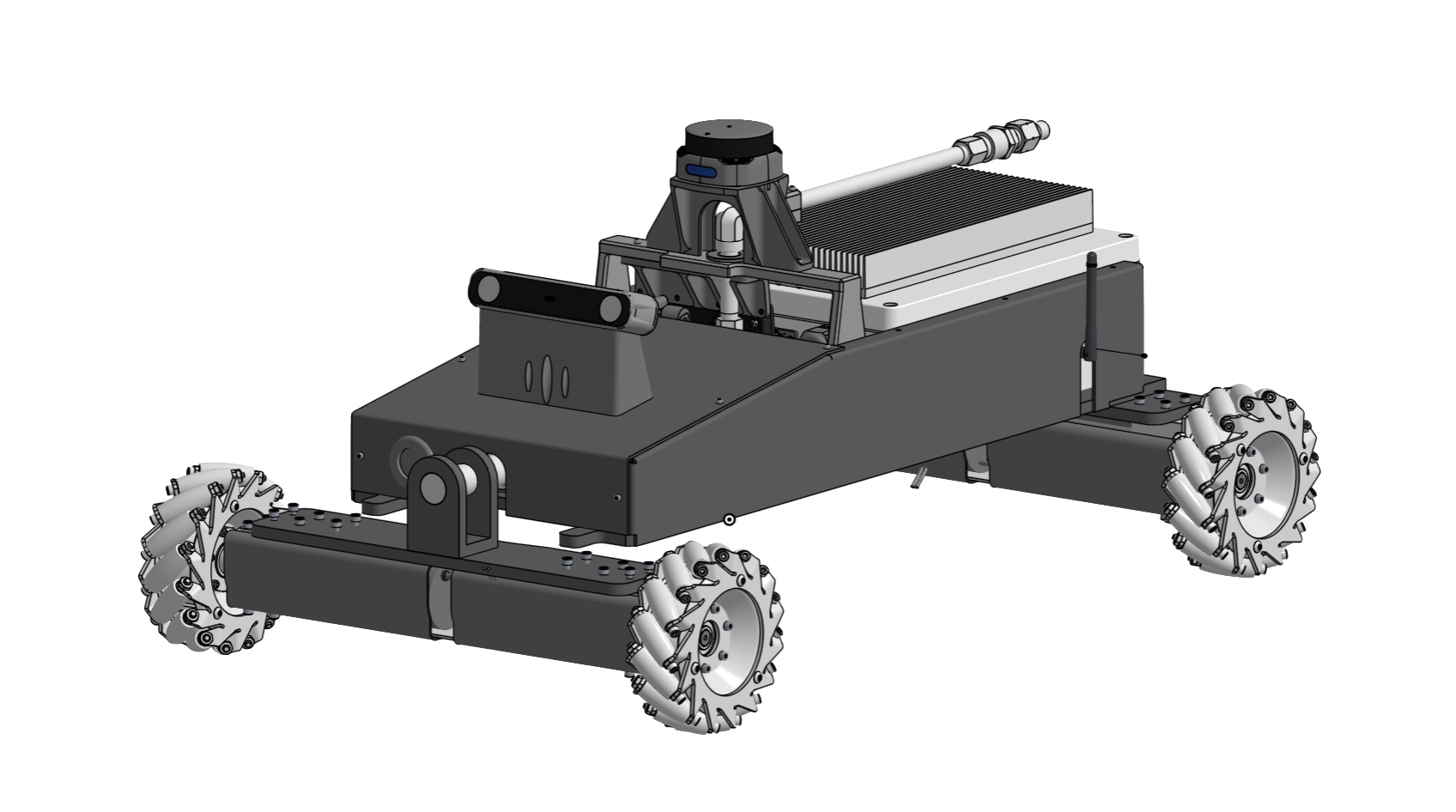
The market is moving toward autonomy and full-building coverage. The Lavo bot addresses indoor commercial cleaning ($70B+ global market), handling floors while the Sherpa handles exteriors. The combination of outdoor drone + indoor robotic cleaning positions operators for comprehensive building maintenance services, a single vendor covering the entire facility envelope.
Ready to Start? Here's Your Next Step
If you've read this far, you're past the curiosity stage. Here's how to move forward based on where you are:
I'm ready to buy or lease. Get a custom quote with bundle recommendations, financing terms, and Refresh options based on your market. Most quotes are delivered within 24 hours.
I want to see it work first. Watch operator footage from real jobs, facades, windows, solar panels, high-rises, or schedule a live virtual demo with the team.
I want to start small. Refresh Launch at $2,500/month. Full Sherpa Drone access, training, and support with no long-term commitment. Prove the economics in your area, then decide.
I need to talk to someone who's done it. With 400+ operator businesses, we can connect you with one in your region who'll give you the unfiltered truth about the business. Hearing from someone who's already doing it is the single most effective way to decide.
I manage a property and need drone cleaning. We'll connect you with a vetted operator in your area. Tell us your building type and location, and we'll match you.
CTA: Get Your Custom Quote, Most Delivered Within 24 Hours | Or: Start With Refresh at $2,500/mo | Talk to an Operator
Regulatory Considerations
Commercial drone operation in the U.S. falls under FAA Part 107 regulations. Key requirements include a Remote Pilot Certificate (Part 107), drone registration with the FAA, Remote ID compliance (required since March 2024), operating below 400 feet AGL (above ground level) unless with waiver, visual line of sight requirements, and restrictions on flying over people without Part 107.39 waiver.
Most commercial cleaning operations fall well within standard Part 107 rules. The Sherpa Drone operates below 300 feet, well within the 400-foot ceiling. Operations occur during business hours in commercial areas, satisfying daylight and populated area considerations. Lucid Bots provides regulatory guidance as part of operator onboarding.
Lucid Bots is a Charlotte-based robotics company building autonomous cleaning drones and robots. Founded in 2018, the company serves over 400 operators across 40+ states with the Sherpa cleaning drone and Lavo AI floor cleaning robot. For more information, visit lucidbots.com.
.avif)
1 Hour, 53 Seconds of Continuous Drone Cleaning
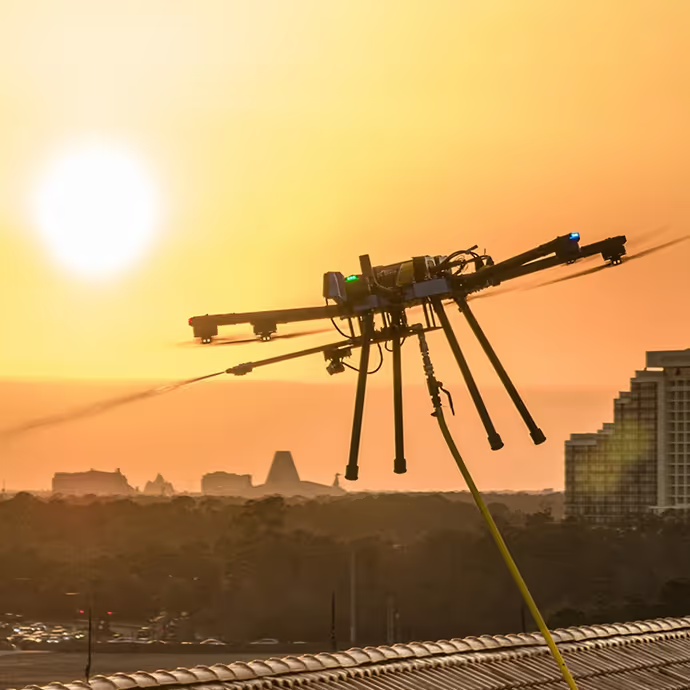
Sherpa Drone just completed 1 hour and 53 seconds of continuous exterior cleaning using Lucid Bots’ new power tether—unlocking effectively unlimited flight time.
Lucid Bots builds U.S-made robots for dirty, dangerous cleaning work.
On a recent exterior cleaning job, Sherpa Drone stayed in the air for 1 hour and 53 seconds of continuous cleaning at 3,500 PSI and 8 GPM.
No battery swaps.
No landing every few passes.
Just steady exterior cleaning at height while the crew stayed on the ground.
Our CEO, Andrew Ashur, put it simply: this was the longest commercial drone cleaning flight we’ve ever seen – and a big step toward making drones a true all-day tool on real jobsites.
Why this flight matters
Until now, drone cleaning has been limited by batteries.
A typical day with Sherpa Drone looks like:
- Clean for 10–20 minutes
- Land
- Swap batteries
- Take off, line up again
- Repeat
It works, but you lose time and rhythm on every swap. Jobs get planned around chargers and packs instead of just buildings, water, and crew.
With our new power tether, that equation changes.
By feeding power from the ground, it gives Sherpa Drone effectively unlimited flight time: the practical limit on a job is no longer at the fault of the drone batteries. Limitations become things like crew endurance, site scheduling, generator fuel, etc. rather than remaining battery capacity. We’re not removing constraints entirely, but we are moving them off the drone’s batteries.
On this record flight, the drone didn’t come down because the battery was dead. It came down because the section of work was done.
That’s the shift we care about.
What actually happened on the job
This wasn’t a lab test or a parking-lot demo. It was a live exterior cleaning job with all the usual constraints.
On this flight:
- Mode: High-pressure exterior cleaning at height
- Runtime: 1 hour, 53 seconds of effectively continuous work
- Pressure / flow: 3,500 PSI, 8 GPM
- Crew: Operators stayed safely on the ground
Sherpa Drone handled every pass on the wall. The crew focused on:
- Managing hoses and water supply
- Watching for quality of clean
- Keeping eyes on the site, not on battery timers
Under the hood, we paired the power tether with updated onboard power electronics designed for long flights. From the operator’s point of view, though, it felt simple:
“It just stayed up and kept cleaning.”
That’s the experience we’re building toward.
What this unlocks for operators
For contractors, facility managers, and building service companies, this milestone shows up in a few concrete ways.
1. More work per crew per day
With no battery swaps, more of the day is actual cleaning. Sherpa Drone becomes an all-day workhorse for glass, facades, and other exterior surfaces at height.
2. Less time in lifts
Sherpa Drone does the work at height so crews can stay safely on the ground. That means:
- Fewer lifts to rent, move, and maintain
- Fewer people working on edges, roofs, or swing stages
3. Simpler planning
Instead of planning around chargers and packs, you plan around:
- Water
- Generator fuel
- Crew schedules
In other words, the things you already think about on a pressure washing job.
What’s next
This was Lucid’s first and longest exterior cleaning jobsite flight with the power tether. It’s a milestone, not the finish line.
From here, our team is focused on:
- Repeating long-duration flights on more buildings and surfaces
- Gathering real-world feedback from operators
- Making the power tether available to more Sherpa Drone customers
We automate the ordinary, so humans can do the extraordinary.
If you want fewer people in lifts and more work done from the ground, talk with our team about using Sherpa Drone with the power tether on your next job.
Facility Maintenance: Lavo Bot AI and NVIDIA Bring Autonomy to Exterior Surface Cleaning
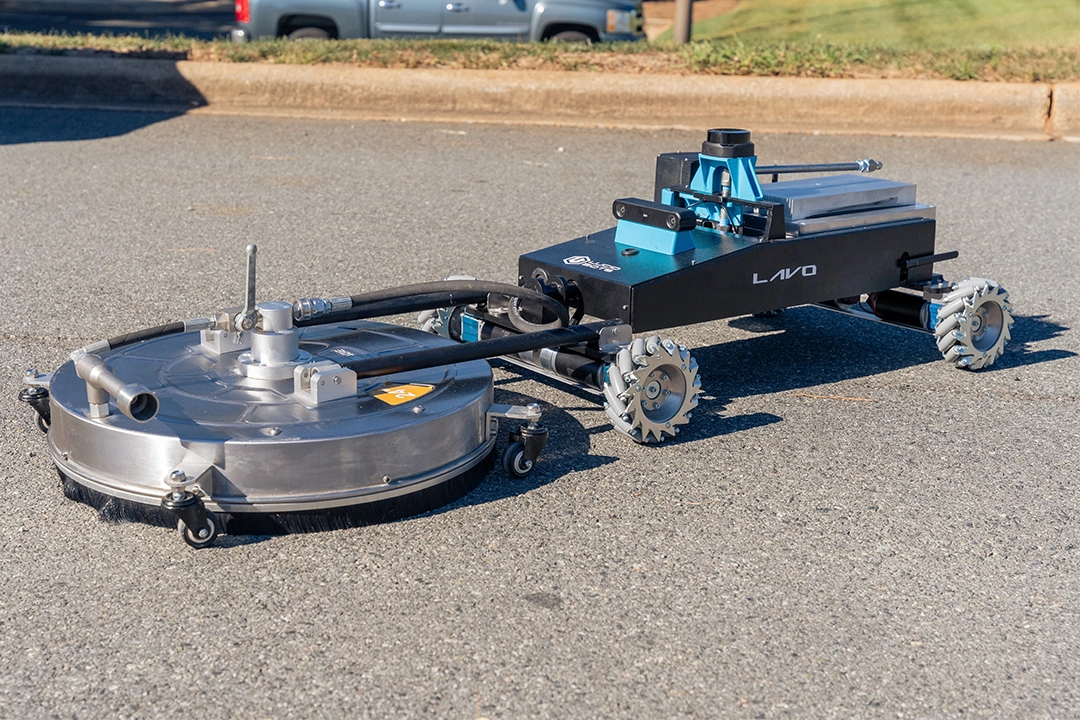
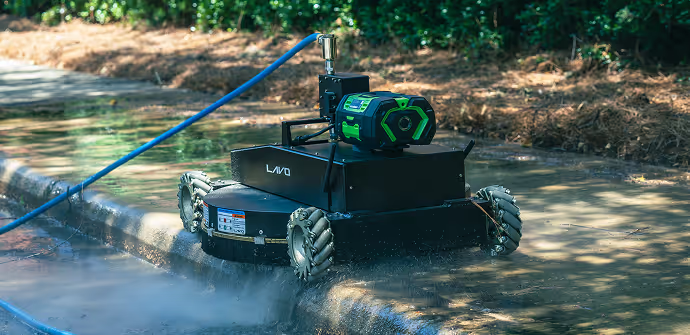
The Lucid Bots Lavo Bot AI, powered by NVIDIA’s edge-compute platform, brings enterprise-grade autonomy to exterior surface cleaning. With intuitive Click-and-Clean job templates in Lucid OS, operators can effortlessly program, save and repeat complex cleaning routes. Equipped with advanced mapping, multi-sensor vision and zone-based safety, the system navigates real-job sites with confidence—handling up to 6,000 sq ft/hour and supporting pressure-wash rigs up to 12 GPM and 4,500 PSI. As facilities face labor shortages, rising costs and mounting demand for consistent cleanliness, Lavo Bot AI offers a scalable solution that augments crews, boosts throughput and elevates quality in exterior maintenance.
A New Era of Autonomous Cleaning: Lavo AI
Lavo Bot AI brings enterprise-grade autonomy to one of the most demanding exterior maintenance tasks. Using Click-and-Clean™ job templates powered by Lucid OS™, operators can set up, save, and repeat complex cleaning routes with only a few taps, eliminating hours of manual prep work.
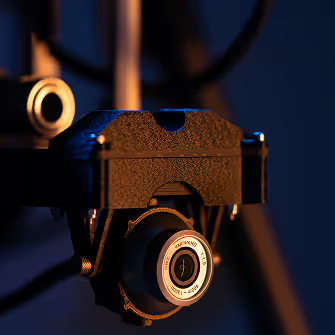
With advanced mapping, full-environment sensing, and powered by NVIDIA edge compute, Lavo Bot AI navigates real facilities with confidence and delivers consistent, high-quality cleaning at scale. This is autonomy designed for real job sites, not just controlled environments.
The system can clean up to 6,000 square feet per hour and integrates with commercial pressure washing rigs up to 20 GPM and 4,500 PSI. Early adopters are already seeing what it means to unlock more output without adding more headcount.
Why it matters
Facility teams are being asked to do more with fewer people as the United States janitorial and building maintenance market reaches ~$108B. Labor shortages continue to grow, service expectations are rising, and operators are under pressure to maintain cleaner, safer exterior environments while also reducing costs. Within this market, exterior surface cleaning alone represents $15 to $22B dollars in recurring annual work, most of which is still performed manually.
Despite the size of the industry, autonomous systems account for well under one percent of all surface cleaning operations today. Most facilities rely on slow and physically demanding manual workflows that limit throughput and make scheduling unpredictable. Lavo Bot AI gives operators an immediate path to higher productivity, consistent quality, and more reliable service delivery. The robot augments crews rather than replacing them and allows existing teams to cover significantly more ground with far less strain, making exterior maintenance more scalable and cost effective.
How It Works
Lavo Bot AI uses the latest NVIDIA edge compute platform to power its autonomy, vision systems, and mapping intelligence. These capabilities allow the robot to move safely through real-world environments and produce enterprise-grade results.
Key capabilities include:
- Autonomy that lasts. Operators can save job areas and rerun them with precise route memory on a recurring schedule.
- Safety for active job sites. Multi-sensor vision systems and zone-based geofencing support safe operation around people and equipment.
- Purpose-built durability. The robot can handle long hose runs and challenging outdoor conditions including grime, gum, grease, and inconsistent surface textures.
Customer perspective
"You recover the investment in just a couple of months," said Francisco Oliveras, owner of PWR Wash PR. "With this approach, you can reduce operating expenses by 40% or more."
Availability
Limited pilot programs begin this winter, with general availability planned for Q2 2026. Pre‑orders open today. Live demo events are scheduled for January.
.svg)
.avif)
.avif)