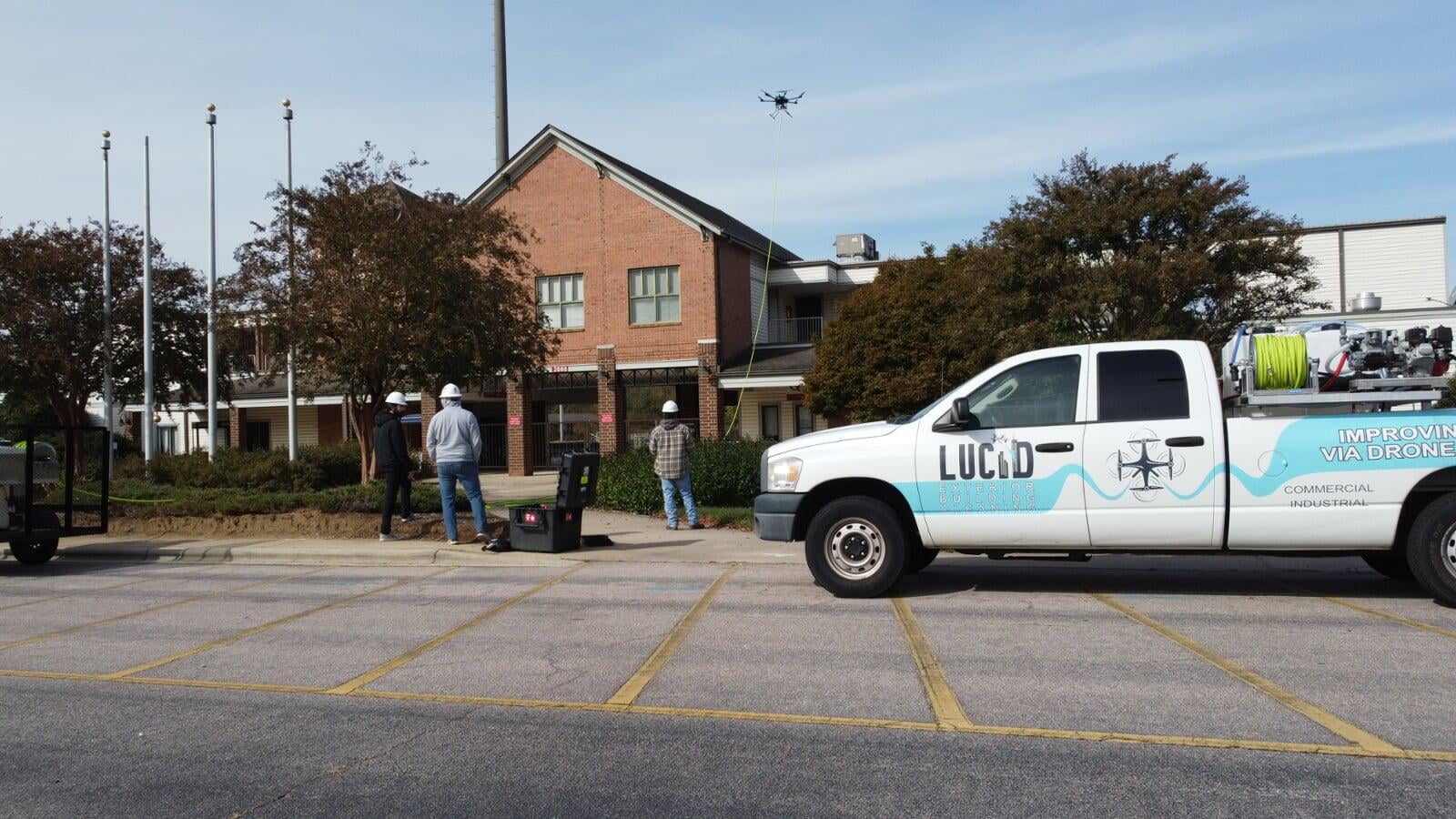
Safely Soft Wash From a Distance With a Drone
Contact us today to schedule a FREE demo and speak with one of our customer service representatives: sales@luciddronetech.com
Summer is in swing, and it's coming in hot with humidity and high temperatures. Summer might be great, but it can be damaging to structures. Discoloration, dust, grime, and organic stains like mold and mildew are just a few things to keep an eye out for. It's a great time to soft wash, just don't get too close. These organic stains can have long-term effects on your health.
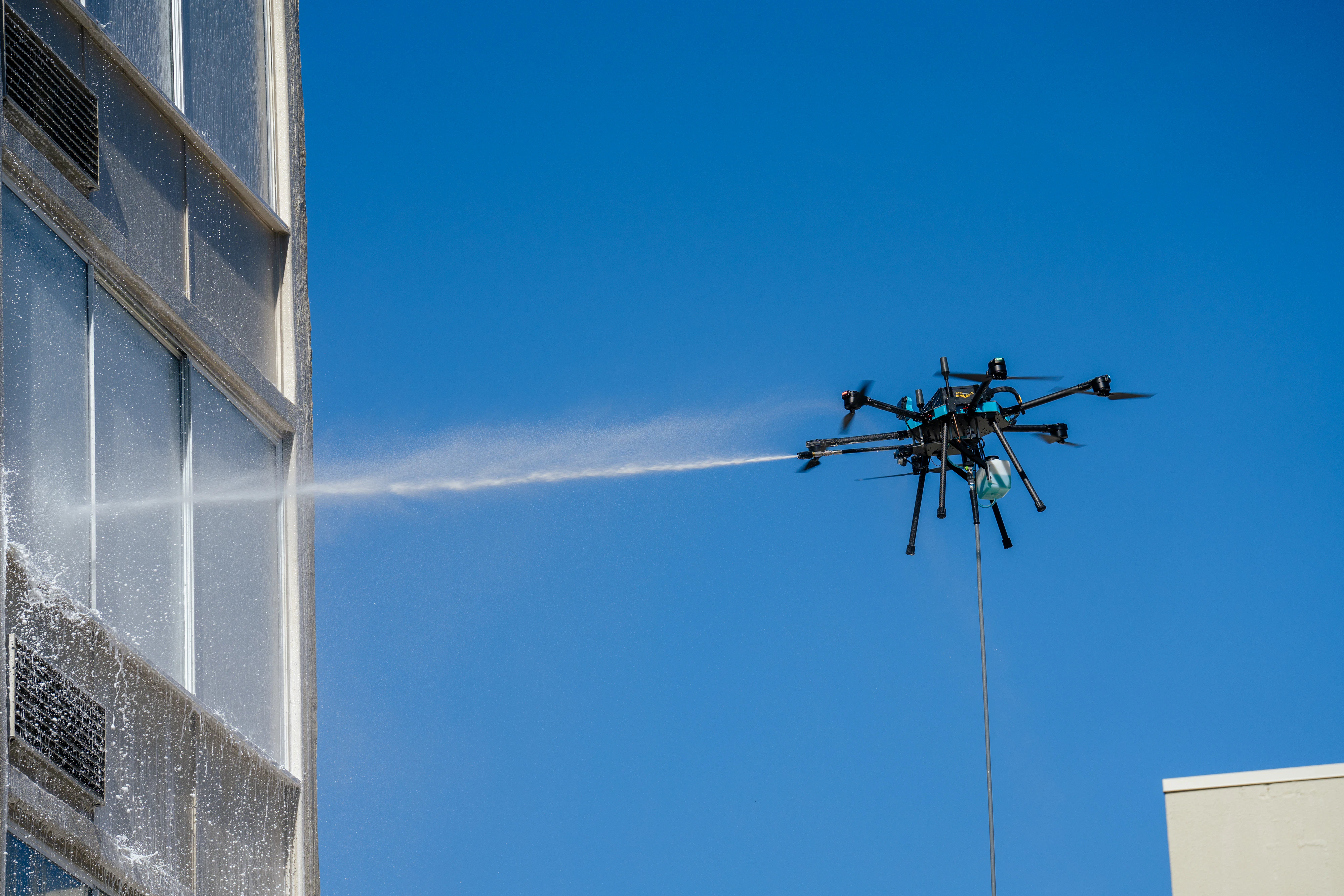
Luckily, drones can be used for safely soft washing surfaces from a distance. Soft washing is the process of using low pressure water to clean exterior surfaces. The best part? Soft washing actually eradicates the damaging organic stains by cleaning the source. This means that you can avoid damaging structures with high pressures and you can ensure that any organic stains, like mold and mildew, are taken care of on the spot.
Plus, with a drone, you can clean areas that are difficult or dangerous to reach, like roofs and tall buildings. Drone technology makes it possible to safely and efficiently clean these areas without having to climb up or get too close. So if you're looking for a safe and effective way to soft wash, consider using a Lucid Bots cleaning drone!
Contact us today to schedule a FREE demo and speak with one of our customer service representatives!
Related Articles

From Maps to Money — How to Build and Scale a Profitable Drone Cleaning Business
Turn market mapping into measurable revenue. Follow this five-week plan to validate demand, win customers, and scale your drone cleaning operation.
This is for drone cleaning operators who are ready to move from exploring the opportunity to actively building a business around it. If you've identified your market, understand the drone advantage, and now want a concrete step-by-step plan to win your first contracts and scale toward six figures, this is your playbook. It's also useful for established operators who want to pressure-test their current growth approach against a proven framework.
You've seen the market size. You've seen why drone cleaning beats traditional methods. Now it's time to go get your share. The operators who succeed in this industry don't wait for leads to find them — they systematically map their market, identify their best targets, and engage directly with the people who make decisions. This blog walks through Lucid Bots' five-step Market Mapping Protocol: a proven week-by-week plan that takes you from a blank spreadsheet to a prioritized target list, direct outreach conversations, and a financial model that shows exactly what consistent execution is worth over three years.
The Five-Step Market Mapping Protocol
Step 1: Google Maps Analysis (Week 1)
One Lucid Bots sales rep did this exercise and found a 60-mile circle around Charlotte, NC contained 25 Hilton properties alone — worth $625,000 in annual cleaning value at $25,000 average per property. He added Marriott, Holiday Inn, and Hampton Inn, and the total grew into the millions before he even searched for office buildings or hospitals.
Run the same exercise in your market. Search within a 60-mile radius for:
- Hotels (search by brand: Hilton, Marriott, Holiday Inn, Hampton Inn, Hyatt)
- Office buildings and corporate campuses
- Warehouses and industrial facilities
- Hospitals and medical centers
Estimate cleaning value by property size:
- Boutique Hotels: $2,000-$4,000
- Mid-Size Hotels: $4,000-$6,000
- Large Hotels: $6,000-$8,000
Do the same exercise for offices and industrial sites. Total the numbers. That's your addressable market.
Step 2: Drive-By Assessment (Week 2)
Take your list of targets and visit 50 properties in person. This step is about observation, not selling. You're looking for:
- Visible staining, algae, mold, or streaking on building exteriors
- Surface types (metal panels, stucco, brick, glass) that affect pricing
- Access conditions (parking lot size, slope, nearby landscaping)
- On-site staff or front desk contacts who can point you to decision makers
Note your observations for each property. This becomes your intelligence file — and your demo target list.
Step 3: Target Market Prioritization (Week 3)
Not all properties are equal. Score each property type on four dimensions:
- Deal size potential
- Sales cycle speed (hotels decide faster than municipalities)
- Competition level in your area
- Recurring revenue potential (will they need this quarterly or annually?)
Focus first on the intersection of high deal size and high repeatability. Hotels and mid-size office buildings typically sit at that intersection — they have visible maintenance needs, predictable budgets, and decision makers who care about the building's appearance.
Step 4: Direct Outreach (Week 4)
The best lead generation tool in drone cleaning isn't an ad — it's a conversation. Use this simple script when you walk into a property:
"Hi, I'm [Name] from [Company]. We clean building exteriors using drone technology. Who handles decisions about exterior maintenance here?"
It's polite, specific, and opens real conversations. If the decision maker isn't available, ask for their name and contact information and follow up directly. If they are available, offer a demo on the spot — you have the equipment in the truck.
Step 5: Financial Modeling (Week 5)
These projections assume 8-10 jobs per month at roughly $3,500 average ticket value — a conservative baseline for operators targeting mid-size commercial properties like hotels and office buildings in most U.S. markets.
- Monthly target: 8-10 jobs x $3,500 average = $28,000-$35,000
- Year 1: $200,000-$400,000
- Year 2: $400,000-$800,000
- Year 3: $800,000-$1,500,000
These aren't fantasy numbers — they're what consistent execution of the four steps above looks like over time.
The Five-Point Market Framework
- Expand Your Vision — Every building exterior is part of one ecosystem. Stop thinking in service silos.
- Use the Google Maps Method — Spend one afternoon mapping your market. You'll be surprised by the total.
- Prioritize Smartly — Focus where deal size and recurring revenue overlap. Hotels and office towers first.
- Engage Directly — Visit, observe, and start conversations. Real relationships beat digital ads every time.
- Track Religiously — Consistent activity creates consistent growth. Log your outreach, your wins, and your losses.
The Final Word
The exterior cleaning market isn't small, slow, or saturated — it's massive, fragmented, and ready for disruption. Drone cleaning doesn't just make the work safer — it makes it scalable.
Start mapping. Start flying. The opportunity is already around you — you just have to see it.
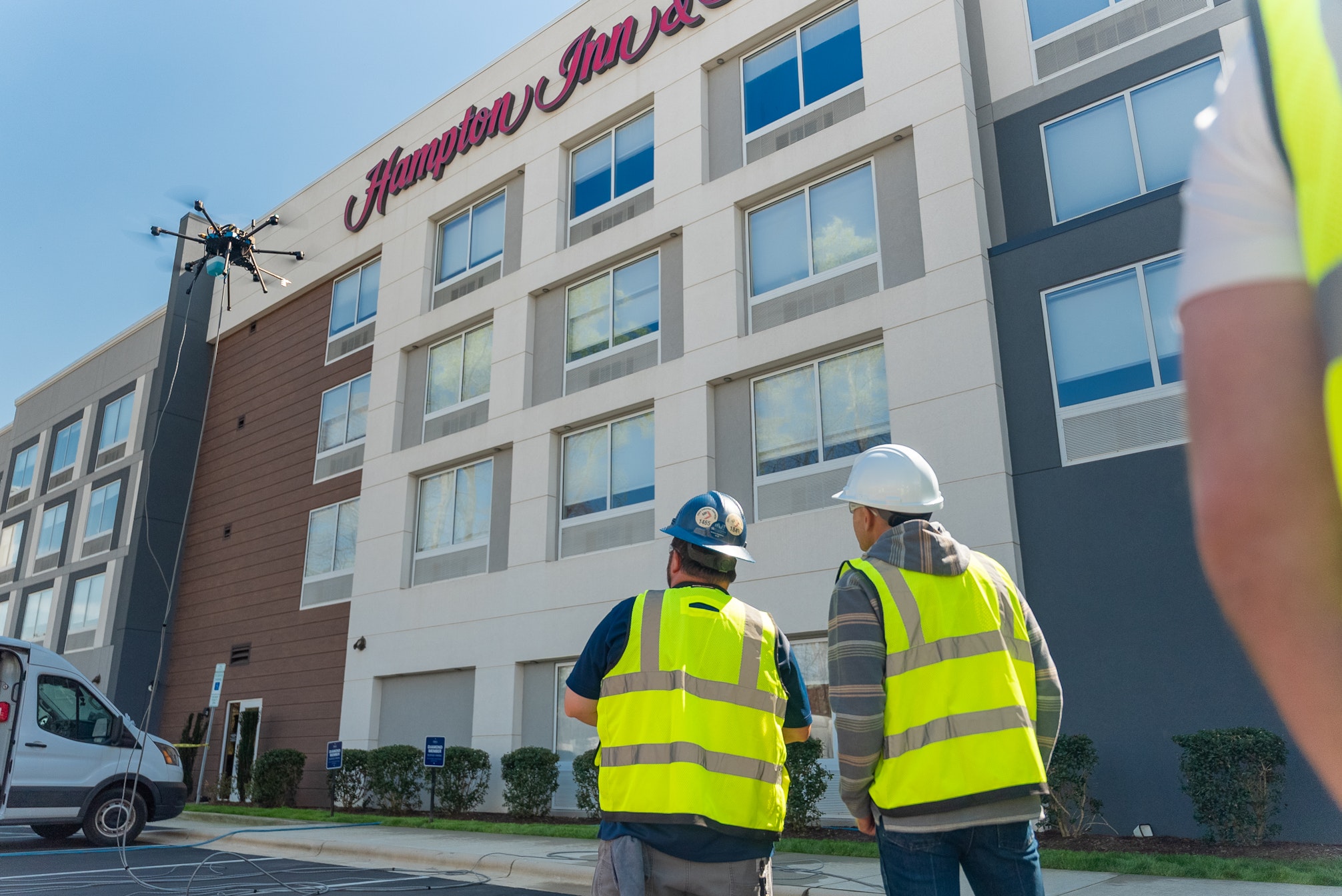
The Drone Advantage — Why Drone Cleaning Beats Traditional Methods
See how drone cleaning outperforms lifts and scaffolds on time, safety, and profit. A direct comparison that proves the future of exterior cleaning is airborne.
This is for drone cleaning operators who need to articulate their competitive advantage clearly — whether you're preparing for a sales conversation, building a proposal, or responding to a prospect who says "we already have a vendor." It's also for property managers and facility directors who are evaluating whether drone cleaning is actually better than what they're currently using. The short answer is yes — and this shows the data.
For decades, exterior building cleaning meant one thing: risk, labor, and lost time. Crews balanced on lifts, battled weather delays, and shut down parking lots for days at a time. Every 20 feet, the equipment had to be repositioned. Every job carried safety hazards that drove up insurance costs and frustrated tenants. Then drone cleaning changed the equation entirely. Today, a two-person drone crew can clean an eight-story building in a single day — with no lifts, less disruption, and dramatically better margins. This post breaks down the head-to-head comparison so you can see exactly where the advantage comes from.
The Four Failures of Traditional Cleaning
1. Repositioning Inefficiency
Lift-based cleaning allows you to cover only about 20 feet before the equipment must be lowered, repositioned, and raised again. On a large building, that process repeats dozens of times — burning hours that add up to days of unnecessary labor and cost.
2. Safety Hazards
High injury rates from lift and scaffold work drive up workers' compensation and insurance costs — a hidden expense that property managers often don't account for until something goes wrong. Falls and near-misses cost lives and dollars. Drone cleaning removes that liability from the equation entirely, keeping operators safely on the ground throughout the job.
3. Equipment Burden
Traditional setups require expensive lift rentals ($400-$1,000 per day), large crews, specialized rigging, and cooperative weather. Any one of those variables can delay or cancel a job, turning a two-day project into a week-long headache.
4. Customer Disruption
Parking lot closures, noise, and extended project durations frustrate tenants, guests, and property managers alike. A hotel that has to apologize to guests for noise and blocked entrances is not a happy client — and not a repeat client.
Head-to-Head: An Eight-Story Office Building
Let's look at a real scenario:
When you put the two methods side by side on an eight-story office building, the difference is hard to ignore. A traditional crew takes three days, requires four workers, and runs between $8,000 and $12,000 in total cost — all while carrying a high risk of injury. A two-person drone crew completes the same job in a single day at $4,000 to $6,000, with a safety profile that's 90% better than lift-based methods. That's a 60-80% reduction in time, a dramatically smaller crew, and equal or better margins — often at a lower price point for the customer.
Result: drone cleaning delivers a 60-80% reduction in time, dramatically improved safety, and equal or better profit margins — often at a lower price point for the customer.
That's the kind of efficiency leap that reshapes industries.
Beyond Efficiency: What Property Managers Actually Care About
Property managers don't choose vendors based on technology — they choose based on outcomes. And drone cleaning delivers on every outcome they care about:
- Safety: No workers elevated, no lift liability, no incident reports
- Speed: One day instead of three means less disruption to tenants and guests
- Consistency: Recurring maintenance plans keep the building looking clean year-round
- Simplicity: One crew, one platform, one vendor relationship
Drone cleaning turns an operational headache into a one-day maintenance win. That's not a feature — that's a business outcome.
The Takeaway
Drone cleaning isn't just a safer method — it's a smarter business model. As costs drop and regulations modernize, operators who adopt now will own the competitive advantage later.
Next: we'll show you how to translate that advantage into predictable, scalable revenue.
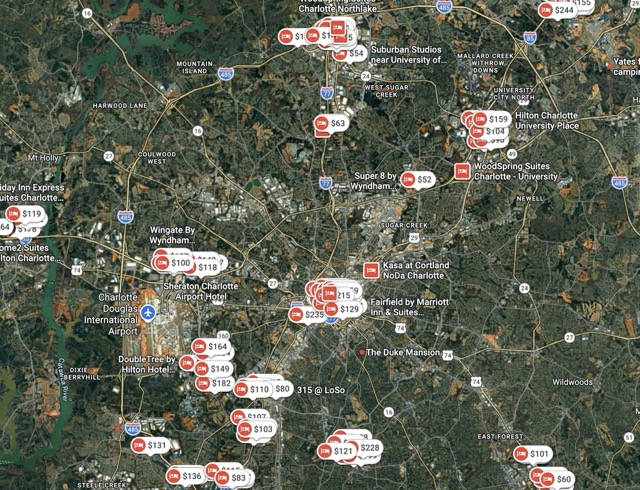
The Google Maps Method — How to Uncover Millions in Local Drone Cleaning Revenue
Turn Google Maps into your market-sizing tool. Learn the simple method that reveals millions in potential drone cleaning contracts around your city.
This is for drone cleaning operators who want a simple, free, and fast way to understand the size of their local market before they spend a dollar on marketing. Whether you're validating a new territory or trying to build a credible pipeline for your first year, this method turns a casual search into a concrete revenue estimate — no expensive research reports required.
What if your next million-dollar opportunity was already sitting inside Google Maps? One Lucid Bots sales rep decided to find out. He drew a 60-mile circle around Charlotte, NC and searched for "Hilton." Twenty-five properties came back. At an average of $25,000 per property in annual cleaning value, that's $625,000 of potential revenue from a single hotel brand. He kept going — Marriott, Holiday Inn, Hampton Inn — and the total grew into the millions before he even searched for office buildings or hospitals. This post walks you through the same exercise so you can run it in your own market today.
The Power of Local Data
That quick exercise revealed a simple truth: you don't need expensive research reports to measure your drone cleaning market — just curiosity and a map.
Here's what a single metro area looks like when you run the full exercise:
- Office Buildings: 500 x $15,000 = $7.5M
- Medical Facilities: 150 x $50,000 = $7.5M
- Industrial Sites: 800 x $10,000 = $8M
Total addressable market in one metro area: over $20 million. That's before you've knocked on a single door.
Try It Yourself — Step by Step
- Open Google Maps and set your base location
- Search for key property types: "hotel," "office building," "warehouse," "hospital," "medical center"
- Log the number of results within your target radius (start at 60 miles)
- Estimate average annual cleaning value by property type
- Multiply and total — that's your addressable market
- Highlight properties within easy driving distance — those are your first-contact targets
Why This Matters
Mapping your market gives you three things most operators lack: confidence, focus, and a measurable opportunity. When you can see the potential in black and white, growth stops feeling hypothetical — it becomes inevitable.
You stop chasing any lead that comes in and start building a prioritized target list. You stop underpricing because you're afraid of losing a job and start quoting with the confidence of someone who knows there's plenty more pipeline behind it.
The Bottom Line
You don't need a research firm. You need an afternoon and a browser tab.
Run this exercise in your market this week. Write down the number you get. That's your opportunity — and it's already waiting.
Next: we'll compare traditional cleaning methods with drone cleaning to show exactly where that opportunity becomes profit.

.svg)
.avif)



.avif)